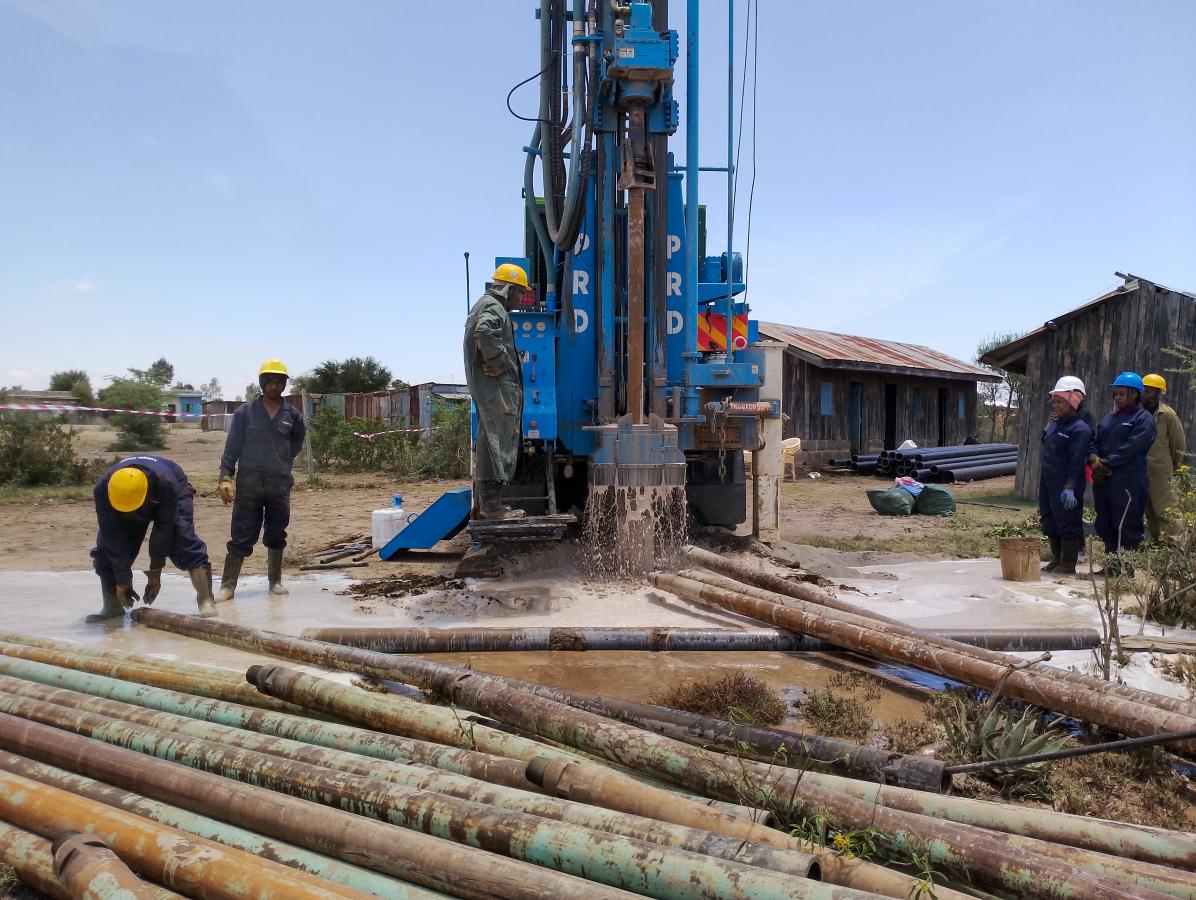
Electromagnetic (EM) methods have emerged as a powerful complement to traditional resistivity surveys across Kenya’s diverse terrains. Particularly valuable in the Rift Valley’s conductive sediments and coastal aquifers, EM techniques provide rapid, non-invasive subsurface profiling to depths exceeding 300m.
This article examines:
-
Fundamental EM induction principles
-
Field deployment protocols for Kenyan conditions
-
Comparative analysis with resistivity methods
-
Special applications in mineral-rich regions
-
Cost-benefit assessment for development projects
Theoretical Framework
Physics of EM Induction
EM surveys measure ground conductivity (σ) by:
-
The transmitter coil generates a primary EM field (f = 0.1-40 kHz)
-
Conductive layers induce secondary eddy currents
-
The receiver coil detects a phase-shifted response
The skin depth (δ) governs penetration:
δ = 503√(ρ/f)
where:
ρ = resistivity (Ωm)
f = frequency (Hz)
Kenyan Geological Response Characteristics
| Formation | Conductivity (mS/m) | Typical Depth (m) |
|---|---|---|
| Lake sediments | 50-200 | 10-150 |
| Weathered basement | 20-50 | 5-80 |
| Fresh volcanic | 1-10 | 30-300+ |
| Marine clays | 100-500 | Surface-50 |
Field Methodology
Equipment Options in Kenya
-
Geonics EM34-3 (Most common for shallow surveys)
-
TerraTEM (Deep penetration systems)
-
GSSI GEM-2 (Multi-frequency systems)
Standard Survey Protocol
-
Frequency Selection:
-
10 kHz for shallow (0-50m)
-
1 kHz for intermediate (50-150m)
-
0.1 kHz for deep (150- 300 m+)
-
-
Grid Design:
-
100m line spacing for reconnaissance
-
20m spacing for detailed mapping
-
-
Data Quality Control:
-
Diurnal variation monitoring
-
Cultural noise assessment
-
Case Study: Baringo County
A 2023 geothermal project:
-
Mapped 15km² conductive zone
-
Identified fault-controlled aquifer
-
Reduced drilling costs by 45% vs test drilling
-
Achieved 18m³/hr sustainable yield
Comparative Analysis
EM vs Resistivity in the Kenyan Context
| Parameter | EM Method | Resistivity |
|---|---|---|
| Survey speed | 5-10 km²/day | 0.5-2 km²/day |
| Depth range | 5-300m | 10-200m |
| Sensitivity | Conductive layers | Resistive layers |
| Terrain constraints | Minimal | Electrode contact needed |
| Equipment cost | 2-3M KES | 0.8-1.5M KES |
Economic Considerations
Cost Structure
| Component | Unit Cost (KES) |
|---|---|
| System rental | 25,000-40,000/day |
| Field crew | 15,000/day |
| Data processing | 500-1,000/sounding |
| Total/km² | 50,000-75,000 |
Technical Challenges & Solutions
Common Field Issues
-
Cultural Noise:
-
Solution: Night surveys in populated areas
-
-
Topographic Effects:
-
Solution: Terrain correction algorithms
-
-
Conductive Overburden:
-
Solution: Multi-frequency inversion
-
Innovative Applications
-
Saline Intrusion Mapping – Coastal aquifers
-
Geothermal Exploration – Rift Valley projects
-
Mine Dewatering – Kakamega Gold Fields
Conclusion
EM methods offer unparalleled efficiency for groundwater reconnaissance across Kenya’s varied geology. When integrated with select resistivity soundings, success rates exceed 90% in properly characterized areas.