As the world moves toward cleaner and more sustainable sources of energy, geothermal power has emerged as one of the most reliable and efficient options. Unlike solar or wind energy, which are intermittent and weather-dependent, geothermal energy provides consistent baseload power—available 24/7, all year round.
But how exactly does geothermal power generation work? What happens beneath the Earth’s surface enables us to produce electricity without burning fossil fuels?
This beginner’s guide breaks down the geothermal power generation process, the different types of plants, and how they contribute to a greener energy future.
1. What Is Geothermal Energy?
Geothermal energy comes from the natural heat stored beneath the Earth’s surface. This heat originates from:
-
The original formation of the planet,
-
Radioactive decay of minerals,
-
And residual heat from volcanic activity.
In certain areas, particularly near tectonic plate boundaries (like the East African Rift Valley), this heat rises close enough to the surface to be accessed via geothermal wells.
The key ingredients for geothermal energy production are:
-
Heat source: Hot rocks or magma.
-
Reservoir: Underground porous rock saturated with hot water or steam.
-
Permeability: Cracks and fractures that allow water to circulate.
-
Water: Naturally occurring or artificially injected into the ground.
2. The Basic Concept of a Geothermal Power Plant
At its core, a geothermal power plant works much like a traditional thermal power plant—but instead of burning coal or gas to create steam, it uses natural underground heat.
Here’s a simplified breakdown:
-
Wells are drilled into the Earth to tap geothermal reservoirs.
-
Hot water or steam is brought to the surface.
-
The steam is used to turn turbines.
-
Turbines drive electric generators to produce electricity.
-
After use, the water or condensed steam is reinjected into the ground to sustain the reservoir.
This process is renewable, sustainable, and low in emissions.
3. Types of Geothermal Power Plants
There are three main types of geothermal power plants, each suited to specific geothermal conditions:
a) Dry Steam Plants
-
Oldest and simplest design.
-
Use steam directly from geothermal wells to turn turbines.
-
No need to separate water and steam.
-
Very efficient if the steam is dry and clean.
Example: Larderello (Italy), The Geysers (USA)
b) Flash Steam Plants
-
The most common type of geothermal plant.
-
Geothermal fluid is high-pressure hot water.
-
As the water rises to the surface, pressure drops, and it “flashes” into steam.
-
The steam is used to spin turbines; the remaining water is reinjected.
Example: Most of Kenya’s Olkaria power stations use flash steam systems.
c) Binary Cycle Plants
-
Ideal for lower temperature resources (100–180°C).
-
Uses a secondary fluid (e.g., isobutane) with a lower boiling point than water.
-
Geothermal water heats this fluid through a heat exchanger.
-
The secondary fluid vaporizes and turns the turbine.
Binary plants emit zero greenhouse gases, making them the cleanest of all.
4. Components of a Geothermal Power Plant
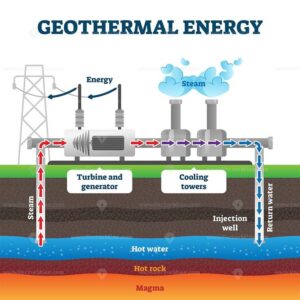
Let’s break down the main components of a typical geothermal power plant:
-
Production wells: Bring hot water or steam to the surface.
-
Separator: In flash systems, it separates steam from water.
-
Turbine: Spins when driven by steam or vapor.
-
Generator: Converts mechanical energy from the turbine into electricity.
-
Condenser: Cools steam back into water.
-
Cooling system: Uses air or water to cool the condenser.
-
Injection wells: Return used geothermal fluid to the reservoir to maintain pressure and sustainability.
5. Environmental and Operational Benefits
Geothermal plants offer numerous advantages over fossil fuel power stations:
-
Low emissions: Carbon footprint is a fraction of coal or gas plants.
-
Minimal land use: Small surface footprint compared to wind or solar farms.
-
Reliable: 95%+ capacity factor; unlike solar or wind, it doesn’t depend on the weather.
-
Renewable: As long as water is replenished, geothermal heat is inexhaustible on human time scales.
-
Safe and quiet: No combustion, no toxic waste, and low noise pollution.
6. Re-injection: Sustaining the Resource
To keep the geothermal reservoir productive, cooled water must be reinjected back into the Earth. This serves three important purposes:
-
Maintains reservoir pressure.
-
Prevents surface subsidence.
-
Ensures long-term sustainability of the geothermal system.
In some systems, water from other sources is added to replenish depleted reservoirs, creating a closed-loop cycle.
7. Geothermal Power in Action: The Kenyan Example
Kenya is a global leader in geothermal energy, especially in Africa. Here’s a snapshot of how Kenya uses this technology:
-
Olkaria Geothermal Complex: Located in Nakuru County, it hosts several flash steam power stations with a total output of over 750 MW.
-
Menengai Field: Operates under a steam supply model where GDC provides steam to private power producers.
-
Baringo-Silali Fields: Under development with great potential for binary and flash systems.
Thanks to geothermal, Kenya now gets over 40% of its electricity from this clean, indigenous source.
8. Future Trends in Geothermal Technology
The world of geothermal energy is evolving fast. Some of the cutting-edge developments include:
-
Enhanced Geothermal Systems (EGS): Artificially create reservoirs in dry rock using hydraulic stimulation.
-
Co-production with oil and gas**: Using hot water from existing oil wells for power generation.
-
Geothermal heat pumps: For heating and cooling buildings directly.
-
Supercritical geothermal: Tapping extremely high-temperature fluids for more efficient energy conversion.
These innovations could make geothermal viable in more regions and at greater scale.
9. Challenges to Geothermal Development
Despite its promise, geothermal energy faces several challenges:
-
High upfront costs: Exploration and drilling are expensive and risky.
-
Site-specific: Not all regions have viable geothermal resources.
-
Long development timelines: Can take 5–7 years to go from exploration to electricity production.
-
Environmental concerns: Risk of induced seismicity, land use disputes, or contamination if not managed well.
Overcoming these barriers requires public-private partnerships, government incentives, and technological innovation.
Conclusion: A Clean, Consistent, and Capable Power Source
Geothermal power plants are marvels of sustainable engineering. By tapping into the Earth’s internal heat, they produce clean electricity with minimal environmental impact—and do so consistently, day and night, rain or shine.
As more countries seek to decarbonize and secure their energy supply, geothermal energy stands out as a foundational technology for a greener future.
Whether you’re an energy enthusiast, a policymaker, or a student of sustainability, understanding how geothermal power plants work is the first step in appreciating one of nature’s most powerful gifts.