As the world transitions toward clean energy, geothermal power is gaining attention for its reliability, sustainability, and efficiency. Unlike solar and wind, which depend on weather conditions, geothermal energy is available 24/7, year-round. But how exactly does this form of energy work? How do power plants tap into underground heat and convert it into electricity that powers homes, businesses, and industries?
This article explains the process in clear, practical terms—from geothermal sources beneath the Earth’s surface to the complex systems that generate clean electricity.
Understanding the Earth’s Natural Heat
The Earth is a massive reservoir of heat energy, generated primarily from two sources:
-
Residual heat left over from the planet’s formation billions of years ago.
-
Radioactive decay of minerals deep within the Earth’s crust and mantle.
At varying depths, this heat can be found in the form of hot rocks, steam, or superheated water stored in underground reservoirs. In regions with active tectonic activity—such as fault lines or volcanic zones, this geothermal energy is much easier to access.
The Basics: What Is a Geothermal Power Plant?
A geothermal power plant is a facility that harnesses underground heat and converts it into electricity. This is achieved by drilling deep wells into the Earth’s crust to access hot water or steam, then using that heat energy to drive turbines connected to generators.
The electricity generated is then transmitted via the grid to power homes, schools, hospitals, and industries, just like electricity from any other source, but with a much smaller environmental footprint.
Types of Geothermal Power Plants
There are three main types of geothermal power plants, each suited to different geological and thermal conditions:
1. Dry Steam Power Plants
These are the oldest and simplest types of geothermal power plants. They use natural underground steam directly to turn turbines.
-
How it works: Steam is extracted from underground reservoirs through production wells and directed into turbines. As the steam spins the turbines, it generates electricity.
-
Where used: This method is effective in areas with abundant steam reservoirs, such as The Geysers in California.
Pros: Simple design, minimal fluid handling.
Cons: Requires rare natural steam fields.
2. Flash Steam Power Plants
Flash steam plants are the most common type in operation today.
-
How it works: High-pressure hot water (usually above 180°C) is extracted from underground and piped into a low-pressure tank. The drop in pressure causes some of the water to “flash” into steam, which then spins a turbine. Any remaining liquid water is either flashed again or reinjected into the reservoir.
-
Where used: Widely used in Kenya’s Olkaria field and other volcanic regions.
Pros: High efficiency, widespread applicability.
Cons: Requires high-temperature water resources.
3. Binary Cycle Power Plants
These are the most flexible and can operate with lower-temperature geothermal resources (as low as 85°C).
-
How it works: Hot geothermal fluid is passed through a heat exchanger, where it heats a secondary fluid (like isobutane or pentane) that has a lower boiling point. The secondary fluid vaporizes and drives a turbine. Importantly, the geothermal fluid never contacts the turbine and is re-injected underground.
-
Where used: Suitable for moderate geothermal zones globally.
Pros: Environmentally safe, closed-loop system, minimal emissions.
Cons: Slightly lower efficiency, more complex technology.
Main Components of a Geothermal Power Plant
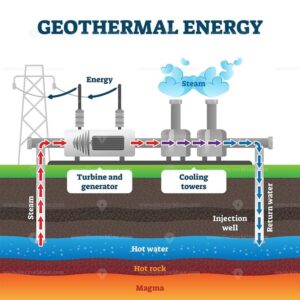
Understanding how geothermal plants work requires a closer look at their components:
-
Production Wells: Deep wells drilled into geothermal reservoirs to bring hot water or steam to the surface.
-
Separator Tanks (for flash systems): Separate steam from water.
-
Heat Exchangers (in binary systems): Transfer heat from geothermal fluid to secondary fluid.
-
Turbines convert thermal energy into mechanical energy.
-
Generators: Transform mechanical energy into electrical energy.
-
Cooling Towers: Cool the steam or secondary fluid so it can condense and be reused.
-
Injection Wells: Return used geothermal fluids back into the Earth to sustain reservoir pressure and resource longevity.
Closed-Loop Sustainability
One of the most important aspects of geothermal power plants is their ability to operate in a closed-loop system. The geothermal fluid extracted is not wasted—it is reinjected back into the Earth. This maintains the pressure and temperature of the reservoir, enabling sustainable, long-term use.
By reinjecting water, operators avoid depleting the underground resource while also minimizing environmental impact and preventing land subsidence.
How Electricity Is Generated and Distributed
Once the turbine spins and the generator produces electricity, the electrical output is stepped up via transformers and sent to the electrical grid. From there, it’s distributed through transmission and distribution lines to consumers.
Geothermal energy seamlessly integrates into existing power infrastructure, making it a viable substitute for fossil fuel-based power plants.
Efficiency and Reliability of Geothermal Power Plants
One of the biggest advantages of geothermal power plants is their capacity factor—a measure of how often a plant operates at full capacity. While solar and wind have capacity factors ranging from 20–40%, geothermal plants often exceed 85–90%, making them one of the most reliable forms of renewable energy.
This high reliability makes geothermal ideal for base load power, the continuous minimum demand on an electrical grid. Unlike solar (limited by daylight) or wind (limited by atmospheric conditions), geothermal delivers consistent output.
Environmental Advantages
Compared to fossil fuel plants, geothermal facilities:
-
Emit minimal CO₂ and no sulfur or nitrogen oxides.
-
Use far less surface land.
-
Produce minimal solid waste.
-
Conserve and recycle water.
Modern geothermal systems, especially binary plants, have a very low environmental footprint. Some newer models are even being integrated with mineral extraction technologies to recover rare earth elements and lithium from geothermal fluids, turning power plants into dual-purpose energy and resource hubs.
Where Are Geothermal Plants Found?
Geothermal plants are mainly located in geothermal hotspots, often along tectonic plate boundaries or volcanic regions. Notable countries with significant geothermal capacity include:
-
USA (California, Nevada)
-
Kenya (Olkaria)
-
Iceland
-
Philippines
-
Indonesia
-
New Zealand
-
Turkey
With technology advancing, even countries without obvious volcanic activity are exploring enhanced geothermal systems (EGS) that artificially create conditions for heat extraction.
Conclusion: Power from the Planet Itself
Geothermal power plants offer an elegant and efficient way to tap into the Earth’s natural heat and transform it into electricity. By utilizing this constant and renewable source of energy, we can reduce our dependence on fossil fuels, lower greenhouse gas emissions, and move closer to a cleaner, more sustainable future.
Whether through dry steam, flash steam, or binary cycle systems, geothermal plants demonstrate how modern engineering can harmonize with natural systems to meet humanity’s energy needs—reliably and responsibly.