Wind energy is one of the fastest-growing sources of renewable energy globally. As the world shifts toward cleaner and more sustainable power sources, wind turbines have become increasingly familiar sights—standing tall in open fields, along ridges, and offshore. But how exactly do these massive structures convert the movement of the wind into usable electricity? This article explores the science and engineering behind wind turbines, from blade mechanics to power generation, offering insight into one of the most efficient green technologies of our time.
What Is a Wind Turbine?
A wind turbine is a device that converts the kinetic energy of wind into mechanical energy, which is then transformed into electrical energy using a generator. Modern wind turbines are complex machines that integrate advanced aerodynamics, mechanical engineering, electronics, and environmental science.
Wind turbines are often categorized into:
-
Horizontal-axis wind turbines (HAWTs): The most common type, with blades rotating on a horizontal axis.
-
Vertical-axis wind turbines (VAWTs): Less common, with blades rotating around a vertical axis; used in niche applications or areas with changing wind directions.
Key Components of a Wind Turbine
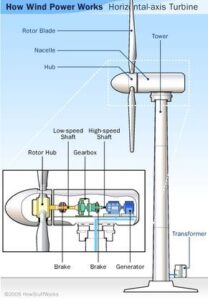
To understand how wind turbines work, it’s essential to explore their main components:
-
Rotor Blades
-
Typically, modern wind turbines have three blades.
-
They are shaped like airplane wings to harness lift, not just drag.
-
Blade length determines how much wind energy can be captured—the longer the blade, the more electricity can be generated.
-
-
Hub
-
The hub connects the blades to the main shaft and allows them to rotate as one unit.
-
-
Nacelle
-
The nacelle is the box-like structure on top of the tower that houses critical mechanical components, including the gearbox, generator, and braking system.
-
-
Gearbox
-
In most turbines, the gearbox increases the rotational speed from the slow-turning blades to the faster speed required by the generator.
-
Some modern turbines use direct-drive systems that eliminate the gearbox, reducing mechanical losses and maintenance.
-
-
Generator
-
Converts mechanical energy into electrical energy through electromagnetic induction.
-
Works on the principle that when a coil of wire moves through a magnetic field, an electric current is generated.
-
-
Yaw System
-
Rotates the nacelle so that the blades always face the wind direction.
-
Uses wind direction sensors and electric motors for alignment.
-
-
Anemometer and Wind Vane
-
These instruments measure wind speed and direction to help the turbine optimize performance.
-
-
Tower
-
Supports the nacelle and blades.
-
Usually constructed of tubular steel and ranges from 80 to 140 meters in height.
-
-
Control System
-
Monitors wind conditions, power output, and mechanical components.
-
Can shut down or adjust operations for safety or maintenance.
-
-
Foundation
-
Typically made of reinforced concrete.
-
Must anchor the turbine and handle the load, especially for offshore installations.
The Science: How Wind Energy Is Converted into Electricity
The functioning of a wind turbine is based on the principles of aerodynamics and electromagnetic induction:
-
Capture of Wind Energy
-
Wind hits the angled blades, creating lift (similar to an airplane wing).
-
This lift causes the blades to spin around the rotor axis.
-
-
Mechanical Rotation
-
The rotating blades turn the main shaft, which is connected to the gearbox.
-
The gearbox increases the rotational speed (e.g., from 30 rpm to 1,500 rpm), which is optimal for the generator.
-
-
Power Generation
-
The generator uses this rotational energy to spin magnets around a coil of wire, inducing an electric current.
-
This electricity is typically alternating current (AC), which is fed into the electrical grid.
-
-
Voltage Transformation
-
Before electricity is transmitted to the grid, it’s passed through a transformer to increase its voltage for long-distance transmission.
-
Wind Speed and Power Output
Wind turbines don’t generate electricity at all wind speeds. They operate within specific thresholds:
-
Cut-in Speed: ~3–4 m/s (the wind speed at which the turbine starts generating power).
-
Rated Speed: ~12–15 m/s (the speed at which the turbine produces maximum power).
-
Cut-out Speed: ~25 m/s (beyond this, turbines shut down to avoid damage).
Power generation increases with the cube of wind speed. This means a small increase in wind speed results in a large increase in power output. For example:
-
Doubling wind speed increases power generation eightfold.
Efficiency and Capacity Factor
No turbine is 100% efficient due to physical and engineering limits. The Betz Limit states that no wind turbine can capture more than 59.3% of the kinetic energy in wind. Most modern turbines achieve 40–50% efficiency, which is considered excellent.
The capacity factor of a wind turbine represents how much energy it actually produces compared to its maximum potential:
-
Onshore turbines: ~30–45%
-
Offshore turbines: ~45–60%
This means turbines are not always generating electricity at full capacity due to wind variability.
Advanced Features in Modern Wind Turbines
-
Pitch Control
-
Adjusts the angle of the blades to optimize energy capture or protect the turbine during high winds.
-
-
Variable Speed Operation
-
Turbines can adjust their rotation speed to match wind conditions and maximize efficiency.
-
-
Remote Monitoring
-
Turbines are connected to SCADA systems for real-time performance tracking, fault detection, and diagnostics.
-
-
Noise Reduction Technology
-
Modern designs include serrated blade edges and other acoustic controls to minimize operational noise.
-
Innovations Shaping the Future of Wind Turbines
-
Floating Wind Turbines: Designed for deep-sea deployment where fixed foundations are impractical.
-
Larger Blades: Turbines with blades over 100 meters long are being developed to capture more energy.
-
Materials Science: Use of lighter, stronger materials to reduce weight and increase durability.
-
AI & Machine Learning: Used for predictive maintenance, weather modeling, and optimizing blade pitch and yaw.
Environmental and Economic Impact
Wind turbines contribute to environmental sustainability in several ways:
-
Zero carbon emissions during operation.
-
Low water use compared to thermal power plants.
-
Land beneath turbines can often be used for farming or grazing.
Economically, wind turbines:
-
Create jobs in manufacturing, construction, and maintenance.
-
Generate stable energy prices by reducing dependence on fossil fuels.
Conclusion
Understanding how wind turbines work reveals just how sophisticated and impactful this green technology is. By converting the invisible force of wind into electricity using a blend of physics, engineering, and innovation, wind turbines are helping reshape the future of global energy. As technology advances, turbines are becoming more powerful, efficient, and accessible, playing a vital role in achieving a cleaner and more sustainable world.