Stratigraphy is a branch of geology that deals with the study of rock layers (strata) and their chronological sequence. It provides insights into the Earth’s history, evolution of life forms, and past environmental conditions through the analysis of sedimentary rocks and their stratigraphic relationships.
Principles of Stratigraphy
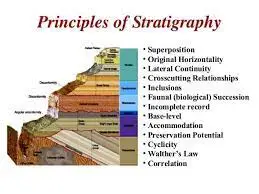
At the core of stratigraphy are several fundamental principles that govern the interpretation of rock layers. These include the Law of Superposition, which states that in an undisturbed sequence of sedimentary rocks, the youngest layers are on top and the oldest are at the bottom.
Types of Stratigraphic Units
Lithostratigraphy
Lithostratigraphy focuses on the physical characteristics of rock layers, such as composition, texture, and sedimentary structures. It involves the classification and correlation of lithologic units based on their lithological properties.
Biostratigraphy
Biostratigraphy relies on the study of fossil assemblages found within rock layers to establish relative ages and correlate sedimentary sequences across different regions. By identifying index fossils characteristic of specific time intervals, biostratigraphers can refine the stratigraphic framework and reconstruct past environments.
Chronostratigraphy
Chronostratigraphy involves the subdivision of geological time into chronostratigraphic units based on age relationships and stratigraphic correlations. These units, such as eons, eras, periods, and epochs, provide a temporal framework for organizing Earth’s history and events.
Methods of Stratigraphic Analysis
Field Observations
Fieldwork is essential in stratigraphic research for documenting and interpreting rock exposures, sedimentary structures, and stratigraphic relationships in the field. Geologists observe and measure rock sequences, record sedimentary features, and collect samples for further analysis.
Laboratory Techniques
Laboratory analysis of rock samples involves petrographic microscopy, mineralogical analysis, and geochemical testing to characterize rock properties and identify sedimentary facies. These techniques provide valuable information about depositional environments, diagenetic processes, and rock formation histories.
Dating Methods
Dating methods such as radiometric dating, paleomagnetic dating, and stratigraphic correlation techniques are used to determine the absolute and relative ages of rock layers. By analyzing isotopic ratios, magnetic polarity, and fossil assemblages, geologists can establish the timing of sediment deposition and geological events.
Applications of Stratigraphy
Geological Mapping
Stratigraphy is crucial for geological mapping and subsurface exploration, particularly in petroleum geology and mineral exploration. By analyzing the distribution and characteristics of rock units, geologists can delineate geological formations, identify potential reservoirs, and assess resource potential.
Petroleum Exploration
In the oil and gas industry, stratigraphy plays a vital role in reservoir characterization, stratigraphic trapping, and basin analysis. Geologists use stratigraphic principles and seismic data to interpret sedimentary sequences, predict reservoir properties, and optimize drilling targets for hydrocarbon exploration.
Archaeological Studies
Stratigraphy is an essential tool in archaeological investigations for reconstructing human history and cultural sequences. By analyzing stratified deposits and artifact assemblages, archaeologists can establish the relative chronology of archaeological sites, reconstruct past lifeways, and interpret cultural changes over time.
Challenges in Stratigraphic Research
Despite its importance, stratigraphy faces challenges such as incomplete stratigraphic records, diachronous boundaries, and tectonic deformation. Resolving these challenges requires interdisciplinary approaches, improved dating techniques, and high-resolution stratigraphic studies.
Future Trends in Stratigraphy
The future of stratigraphy lies in integrating advanced technologies such as remote sensing, high-resolution imaging, and computational modeling. By combining traditional field methods with digital data acquisition and analysis techniques, researchers aim to enhance stratigraphic resolution, accuracy, and predictive capabilities.
Conclusion
Stratigraphy provides a powerful framework for understanding Earth’s history, geological processes, and environmental changes through the analysis of sedimentary rock layers. From geological mapping to archaeological reconstructions, its applications are diverse and interdisciplinary. As technology advances and interdisciplinary collaborations grow, stratigraphy will continue to be a cornerstone of geological research and exploration.